
Specifying the wrong vacuum sausage filler capacity costs more than the price difference between models. An undersized machine becomes the bottleneck within 12 months as production ramps; an oversized one runs at 40% utilisation and wears unevenly. This guide maps the practical operating envelope of 3,000 kg/h, 5,000 kg/h, and 6,500 kg/h industrial sausage filling machines — what each tier actually delivers, where each breaks down, and how to match capacity to your line architecture.
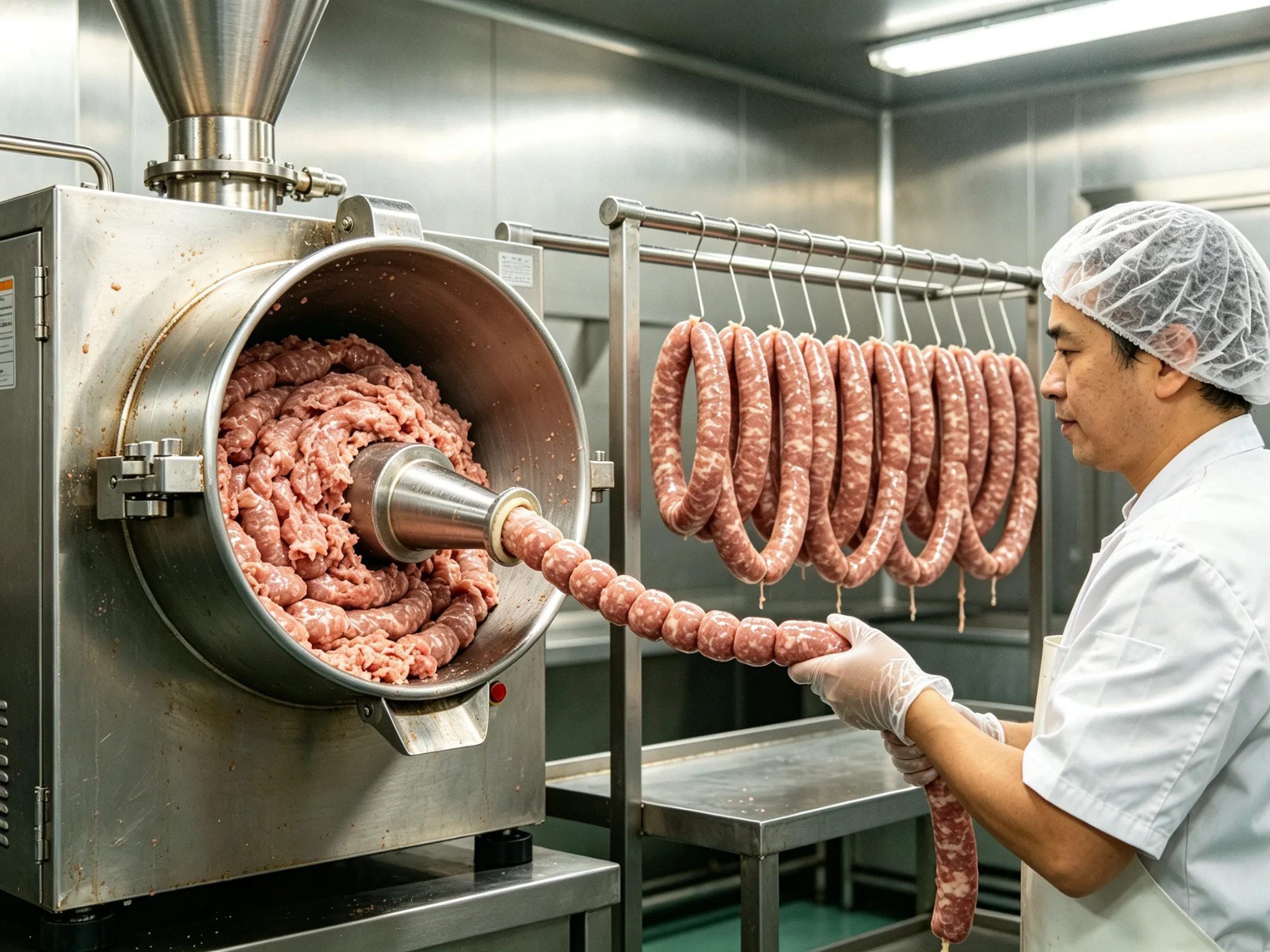
How Sausage Filler Capacity Is Actually Measured
Published capacity figures for sausage filling machines are maximum figures under optimal conditions: ideal paste viscosity (−1°C to +2°C), continuous hopper feed, matched downstream line speed, and standard caliber casing (typically 22–26mm collagen). Real-world throughput is 75–90% of the nameplate figure for most production environments. Understanding the gap between nameplate and real output is where capacity planning starts.
Paste Temperature Effect
At +5°C instead of 0°C, throughput drops 8–12% on vane-type fillers as paste viscosity decreases and vacuum compensation increases.
Hopper Refill Downtime
Manual loading causes 4–8% throughput loss per shift. Automated lift-and-tip loading (T200 lifter) reduces this to under 1%.
Casing Caliber Effect
Small-caliber casings (14–18mm) reduce throughput 15–25% versus standard caliber; large-diameter (38mm+) reduces 5–10%.
Downstream Line Speed
If the clipping or hanging unit is the bottleneck, the filler’s real output is capped at the downstream unit’s capacity regardless of its nameplate figure.
3,000 kg/h Vacuum Sausage Filler: Right Application Profile
A 3,000 kg/h filler serves plants producing 15,000–25,000 frankfurter-weight links per shift (8h) at typical yields. This capacity tier is well-matched to: single-product specialty sausage lines with frequent changeovers, co-packing operations with variable product mix, and plants where downstream capacity (smoking, chilling, packaging) limits total output below 3,000 kg/h regardless of filler capability.
The 3,000 kg/h tier offers the lowest acquisition cost and smallest footprint — relevant where floor space is constrained or multiple product lines share the same facility. Vane-type machines at this capacity class are compact enough to be repositioned between production areas, giving operational flexibility that larger-capacity machines cannot match.
5,000 kg/h Vacuum Sausage Filler: The Industrial Workhorse
The 5,000 kg/h tier covers the majority of industrial sausage plant requirements. It handles frankfurter, hot dog, bratwurst, and coarse-grind formats on the same machine with nozzle changes, and it runs continuously at 85–90% utilisation without the thermal management challenges that arise at the top end of the capacity range.
This tier becomes the right choice when: daily output requirements fall in the 30–50 tonne range, when the plant produces more than three product formats per week (requiring faster nozzle changeovers at moderate speed rather than maximum-throughput single-product operation), and when the downstream line includes a smoke house with fixed batch capacity that limits effective hourly output anyway.
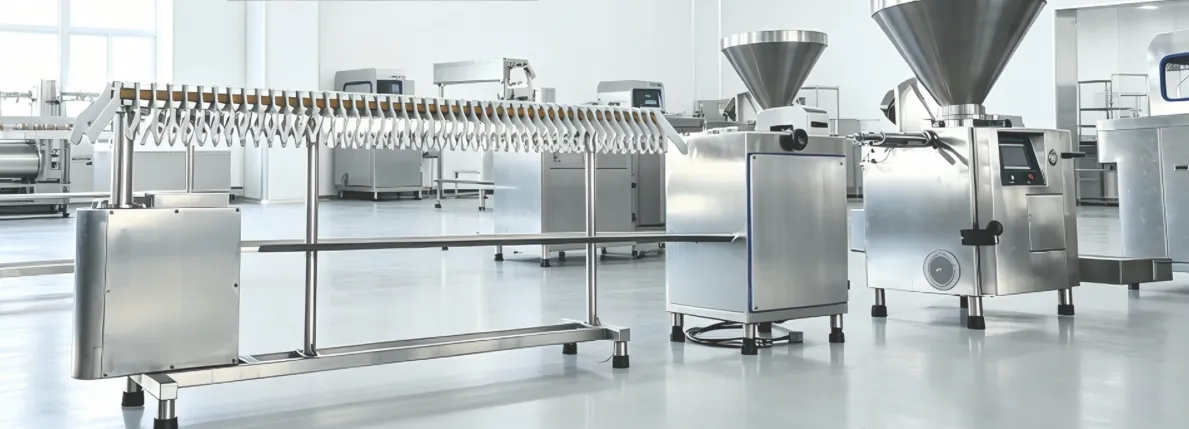
6,500 kg/h Vacuum Sausage Filler: Maximum Throughput Applications
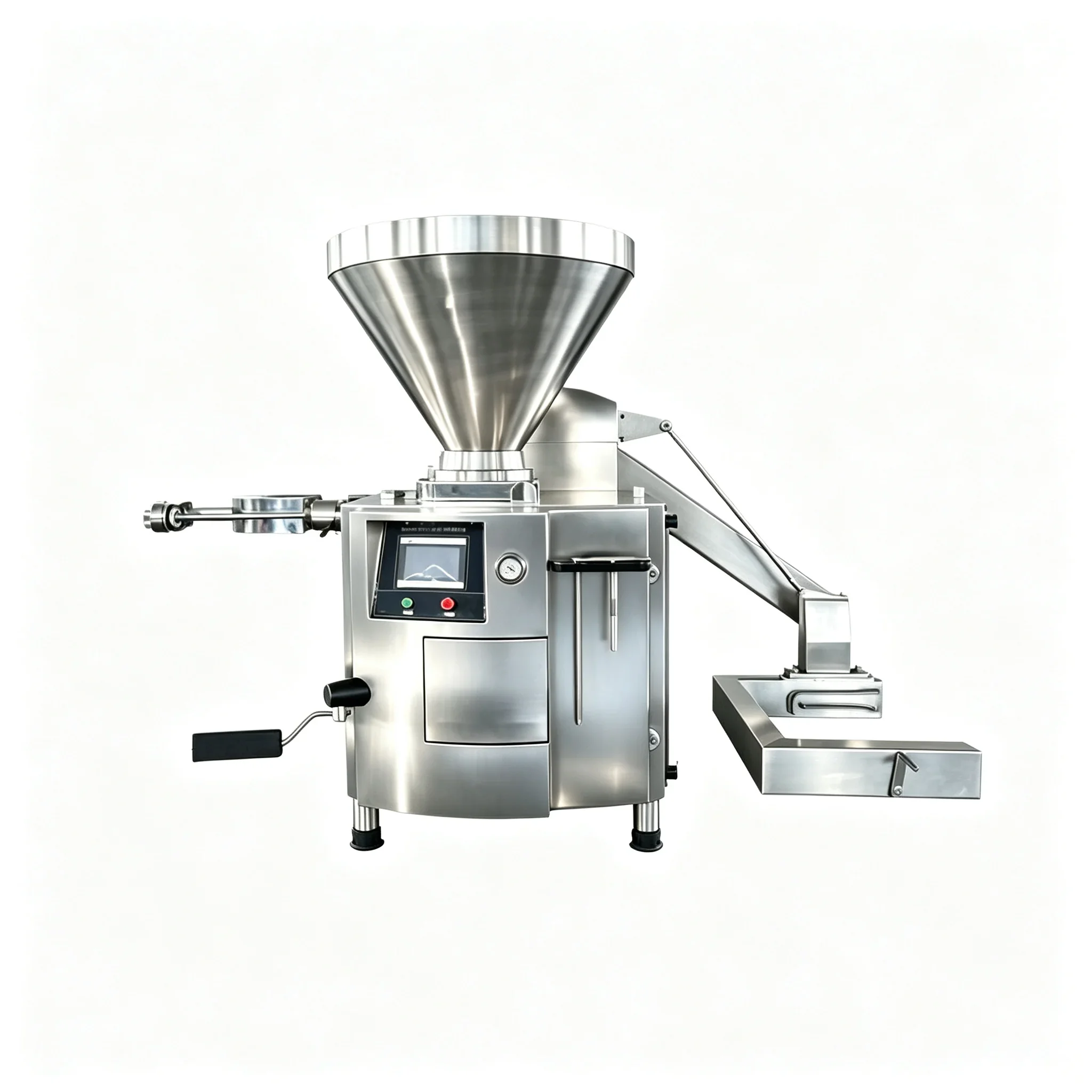
The ZKG-6500 at 6,500 kg/h is a dedicated high-volume machine optimised for single-format continuous production: frankfurters, cocktail sausages, or hot dogs running on a 22–26mm collagen casing with automated hopper loading and PLC-synchronised downstream line. At this capacity, the machine architecture differs meaningfully from the 3,000/5,000 tiers — the vane rotor is larger, vacuum pump capacity is higher, and the servo drive system is more sophisticated.
The 6,500 kg/h tier is the right choice when: daily output requirements exceed 50 tonnes, when the line runs a single product format for 16+ hours per day, when automated hopper feeding is in place, and when the full downstream line (clipping, hanging, cooking, chilling, packaging) is sized to match this throughput. Running a 6,500 kg/h filler into a downstream line sized for 4,000 kg/h simply creates an expensive buffer — the filler’s capacity is never realised.
Side-by-Side Capacity Comparison
| Specification | 3,000 kg/h | 5,000 kg/h | 6,500 kg/h |
|---|---|---|---|
| Typical daily output (2 shifts) | 40–48 tonnes | 70–80 tonnes | 90–104 tonnes |
| Minimum casing caliber (at full speed) | 18mm | 18mm | 18mm |
| Recommended hopper feed method | Manual or lift | Lift recommended | Automated lift required |
| Downstream line requirement | Standard clipper + hanger | Synced clipper + hanger | Full PLC-sync line required |
| Floor area (approx.) | 3.5 × 1.8m | 4.2 × 2.0m | 4.8 × 2.2m |
| Changeover time (nozzle + program) | 15–20 min | 20–25 min | 25–30 min |
| Best fit: production pattern | Multi-format, frequent changeover | Mixed, 1–3 format per day | Single format, high volume |
| Vacuum system | Single-stage | Dual-stage | Dual-stage, high-capacity pump |
Making the Capacity Decision: A Practical Framework
Start from your bottleneck, not from the filler. Map your downstream capacity first: how many kg/h can your clipping unit, smoke house, chiller, and packaging line handle simultaneously? The filler should be specified to match the tightest downstream constraint plus a 15–20% headroom for planned capacity expansion.
When to Choose 3,000 kg/h
Your downstream capacity ceiling is below 2,800 kg/h, or you require operational flexibility (repositioning, multi-line use, frequent product changeover). Capital preservation is a priority and volume growth is uncertain.
When to Choose 5,000 kg/h
Your downstream line handles 4,000–5,000 kg/h continuously, you produce 2–4 formats per day, and you run 2-shift operations. This tier hits the best cost-per-kg-output ratio for most mid-size industrial sausage plants.
When to Choose 6,500 kg/h
Your entire line is sized at or above 6,000 kg/h, you run a single format for extended periods, automated hopper loading is in place, and your volume justifies the additional capital cost. Confirm downstream capacity before committing.
Ready to Optimise Your Sausage Production Line?
Send us your output targets and casing spec — we respond within 48 hours.
+86 13083988828 | ✉ [email protected]