
Air pockets in collagen casing are not just a cosmetic defect — they trigger burst casings, uneven cooking, and customer returns that erode margin fast. At output rates approaching 6,500 kg/h, the margin for error on a vacuum vane filling machine narrows considerably. This guide walks production managers and line engineers through every mechanical and operational variable that determines whether your collagen sausage exits the filler dense, uniform, and casing-ready — or pocked with voids that force rework.
Why Air Pockets Form in Collagen Casing at High Output
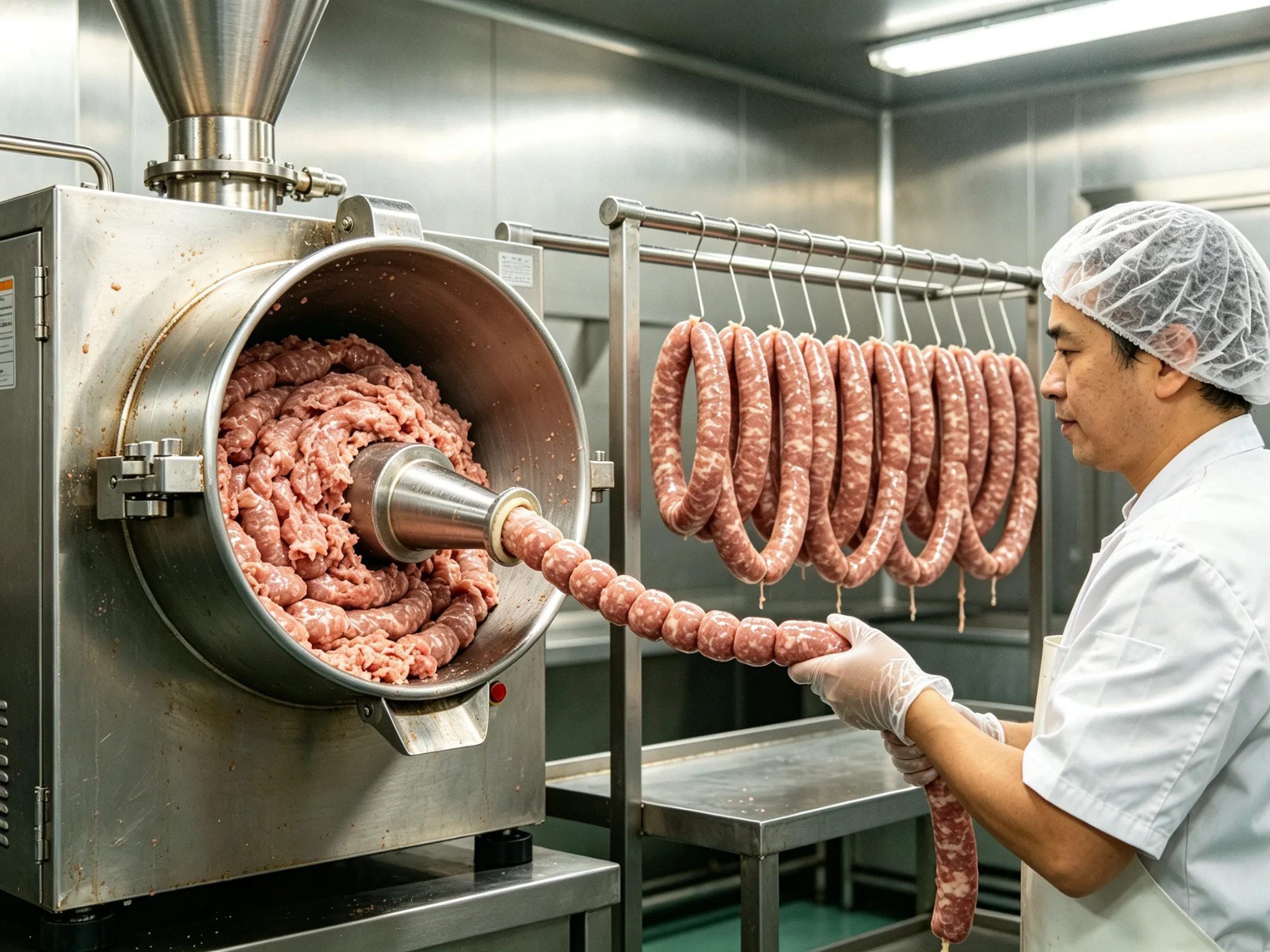
Understanding the root cause is the only way to eliminate the symptom for good. In any sausage filling machine operating above 4,000 kg/h, three mechanisms independently introduce air: entrained gas in the meat emulsion itself, mechanical gaps in the feed path, and turbulence at the stuffing horn exit. Collagen casing is less forgiving than natural gut — it does not stretch to accommodate voids the way intestinal casing does, so even small pockets become visible bulges or rupture points under smokehouse or steam-cooking pressure.
Entrained Air in the Emulsion
Bowl cutters and mixers that run too fast, or that process partially frozen blocks without adequate pre-conditioning, whip air into the protein matrix. Once emulsified, those micro-bubbles resist gravity separation and travel directly into the filler hopper. A vacuum filling machine with a chamber vacuum of −0.8 bar or better will pull the majority of these bubbles out before the emulsion reaches the vane assembly, but the vacuum system must be serviced correctly to maintain that draw across an entire shift.
Mechanical Feed Gaps and Hopper Bridging
When the hopper runs below 30% capacity, the vane pump can momentarily lose prime — drawing in air along with the remaining emulsion. This is most common at the end of a batch load or when operators delay refilling. High-speed processed meat equipment lines operating at 6,500 kg/h burn through a standard hopper in minutes, making continuous or semi-continuous loading essential. Hoppers fitted with agitator paddles help prevent bridging in fatty or cold emulsions, and the drive speed of those paddles needs tuning to the specific recipe viscosity rather than left at a factory default.
Setting the Vacuum System for Zero-Void Collagen Filling
The vacuum circuit on a high-capacity vacuum vane filler comprises the chamber seal, the rotary vane pump, the extraction line, and the separator bowl. Each component is a potential failure point that reduces effective vacuum below the threshold needed to degass emulsion adequately. At 6,500 kg/h throughput, even a worn vane seal that drops chamber vacuum from −0.85 bar to −0.60 bar can increase air pocket incidence by 30–40% — a shift-level quality problem that is invisible until product hits the oven.
Target Vacuum Parameters by Emulsion Type
| Emulsion Type | Min. Chamber Vacuum | Recommended Vane Speed | Horn Diameter |
|---|---|---|---|
| Fine-ground frankfurter / hot dog | −0.85 bar | High (≥ 85% max) | Φ18–22 mm |
| Coarse-ground pork / beef sausage | −0.75 bar | Medium (60–75%) | Φ28–36 mm |
| High-fat / emulsified chicken | −0.80 bar | Medium–High (70–85%) | Φ22–28 mm |
| Whole-muscle / chunky filling | −0.65 bar | Low (40–60%) | Φ38–52 mm |
Separator Bowl and Moisture Management
The vacuum separator bowl collects moisture drawn from the emulsion. At sustained 6,500 kg/h operation it fills faster than many operators expect — typically every 45–90 minutes depending on emulsion moisture content. An overfull bowl floods the vacuum pump with liquid, damaging the vanes and collapsing the vacuum draw within minutes. Build a timed drain check into every operator shift card, and consider upgrading to an auto-drain float valve if your line runs continuously through breaks.
Vane Assembly Condition and Stuffing Horn Selection
The rotary vane mechanism is the heart of any vane-type vacuum filling machine. Each vane sweeps a precise volume of emulsion through the chamber per revolution, which is what gives vane-type fillers their weight-accuracy advantage over piston or twin-screw alternatives. But accuracy degrades with vane wear. A worn vane set not only allows back-pressure to collapse portion weight, it also opens clearances through which air re-enters the filling chamber — directly undermining whatever vacuum the pump has established.
Stuffing Horn Changeover: 4-Step Process for Collagen Casing
Match Horn Bore to Casing I.D.
Select a horn whose outer diameter is 2–3 mm less than the nominal casing inner diameter. Oversized horns stretch collagen and weaken the casing wall before filling even begins.
Lubricate Horn Before Casing Loading
Apply a thin film of food-grade lubricant or cold water to the stuffing horn before threading on the collagen casing. Dry horns create friction bursts, particularly on narrow-diameter casings under Φ22 mm.
Set Casing Brake Tension
Casing brake resistance determines how fast the casing peels off the horn. Too little tension creates loose, air-filled sausage; too much causes casing tear. Start at 60% of maximum brake setting and adjust upward in 5% steps while monitoring diameter consistency.
Run a 10-Piece Qualification Fill
Before committing to a full batch, fill 10 sausages and check for visible voids at both ends, diameter uniformity along the length, and surface blistering. Only proceed when all three pass.
Balancing Line Speed and Portion Control at 6,500 kg/h
Pushing a vacuum sausage filler to maximum throughput without tuning the portion controller is how weight-deviation problems begin. At 6,500 kg/h the machine executes hundreds of portion cycles per minute, and a 0.5% drift in vane speed translates to a perceptible weight deviation across a product batch. The PLC portion-control system uses encoder feedback from the vane shaft to trim fill volume in real time, but that feedback loop only works when the encoder is clean and the servo response time is correctly calibrated for the emulsion density being processed.
Temperature’s Effect on Volume Accuracy
Emulsion temperature directly affects density, and density affects volumetric portion accuracy. Most industrial sausage filling machines calibrate their portion programs at a nominal emulsion temperature of 0–4°C. If material entering the hopper has warmed above 6°C during a long mixing cycle, the measured portion weight will be lighter than the set point — not because the machine is malfunctioning, but because the density assumption is no longer valid. Monitor emulsion temperature at the hopper inlet with a calibrated probe, and build a temperature-compensation multiplier into the portion program if your process routinely sees incoming material above 4°C.
Synchronising Filler Speed with Downstream Clipping
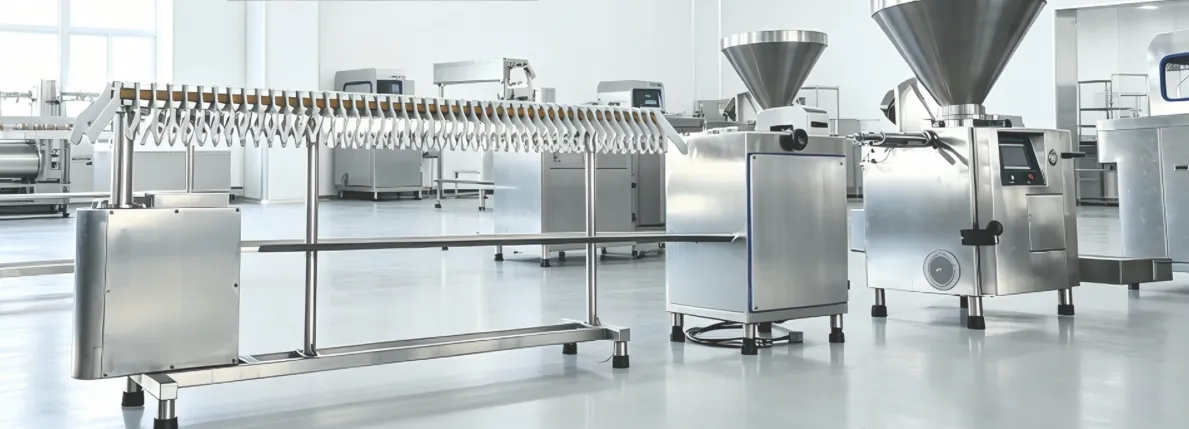
A vacuum vane filler running at 6,500 kg/h must be tightly synchronised with its downstream automatic clipping or linking line. When the clipper lags behind the filler, casing accumulates between the two machines, creating irregular sausage lengths and intermittent tension spikes that burst collagen. Use the filler’s synchronisation output signal — an analog 0–10 V or digital encoder pulse — to slave the clipper drive directly to filler vane speed, so both machines accelerate and decelerate in lockstep.
Collagen Casing Handling Practices That Prevent Air Voids
Even a perfectly calibrated vacuum filling machine will produce air pockets if the casing arrives at the stuffing horn improperly conditioned. Collagen casing shipped and stored at low humidity becomes brittle and cracks under the filling pressure, creating micro-leaks that re-introduce air into the just-filled sausage. Conversely, over-soaked casing loses tensile strength and stretches unevenly, masking air pockets during filling that only become visible once the casing dries and contracts in the smokehouse.
Pre-Conditioning Protocol
For most collagen casings in the Φ15–Φ30 mm range, a 20–30 second dip in water at 30–40°C immediately before threading onto the stuffing horn achieves adequate plasticisation without over-softening the wall. Do not pre-soak an entire batch hours in advance — wet collagen sitting in open trays reabsorbs surface moisture unevenly and degrades the bite texture of the finished sausage. Condition casing in small quantities, threading one shirred stick at a time as the previous one nears completion on the horn.
Storage Conditions for High-Speed Lines
Collagen casing should be stored at 15–22°C and 65–75% relative humidity. Below 50% RH the material becomes stiff enough that it will not conform smoothly to the stuffing horn exit and will trap small air columns between the horn surface and the casing interior before any meat arrives. On sausage production lines running in cold rooms or chilled processing areas, keep casing in insulated boxes until immediately before use, since cold room air at 4°C and 40–50% humidity desiccates the casing rapidly.
Maintenance Schedule to Keep Air-Pocket Rate Below 0.5%
Preventive maintenance on a high-capacity vacuum vane filling machine is not optional at 6,500 kg/h — it is the mechanism by which the air-pocket rate stays within acceptable limits. Every component that degrades silently — vane surfaces, lip seals, vacuum hoses, gaskets — shows up first as a quality problem rather than a machine alarm. Building a structured maintenance cadence that catches these before they affect product is the difference between a line that runs reliably at specification and one that creeps toward chronic rework.
| Interval | Component | Action | Reject Threshold |
|---|---|---|---|
| Every shift | Separator bowl | Drain collected moisture | Do not exceed 75% fill level |
| Every shift | Hopper agitator paddles | Inspect for fat build-up, clean CIP | Any visible obstruction |
| Weekly | Vacuum chamber seals | Visual check + vacuum draw test | Vacuum loss > 0.08 bar vs baseline |
| Monthly | Rotary vanes | Measure wear; rotate or replace | Vane length reduction > 1.5 mm |
| Quarterly | Portion encoder | Calibration check against test weights | Weight deviation > ±2g on 100g portion |
| Quarterly | Vacuum pump oil | Change and filter check | Discoloured or emulsified oil |
Troubleshooting Air Pocket Defects During Production
When air pockets appear mid-run on an otherwise well-setup sausage production line, the fastest diagnostic path follows the sequence: vacuum → feed → horn → casing. Check the vacuum gauge first — a reading more than 0.1 bar below your established baseline points to a seal or pump issue. If vacuum is normal, check hopper fill level; a nearly empty hopper is the second most common mid-run cause. If the hopper is adequately filled, inspect the stuffing horn for a casing pinhole or micro-tear at the horn exit — sometimes a casing defect is the source rather than the machine.
Symptom: Air Pockets Only at Batch Start
If air pockets appear in the first 15–20 sausages of a new batch and then disappear, the most likely cause is trapped air in the horn from the previous changeover. When the stuffing horn is removed and re-fitted between batches, a column of air sits between the horn exit and the emulsion front. Run the filler slowly for 5–6 seconds before engaging the casing brake to purge that trapped air column; at full speed it enters the casing faster than it can be displaced.
Symptom: Intermittent Voids Throughout the Batch
Random voids scattered through a batch without any pattern almost always indicate a worn vane or a vacuum seal that is marginal — holding adequate vacuum at idle but losing it under the pressure cycling of continuous operation. This is the most insidious defect pattern because it cannot be reproduced during a static machine test. Replace vanes proactively on a mileage schedule rather than waiting for measurable wear, and test chamber seals under simulated full-speed pressure rather than just at rest.
Why Choose Processed Meat Equipment
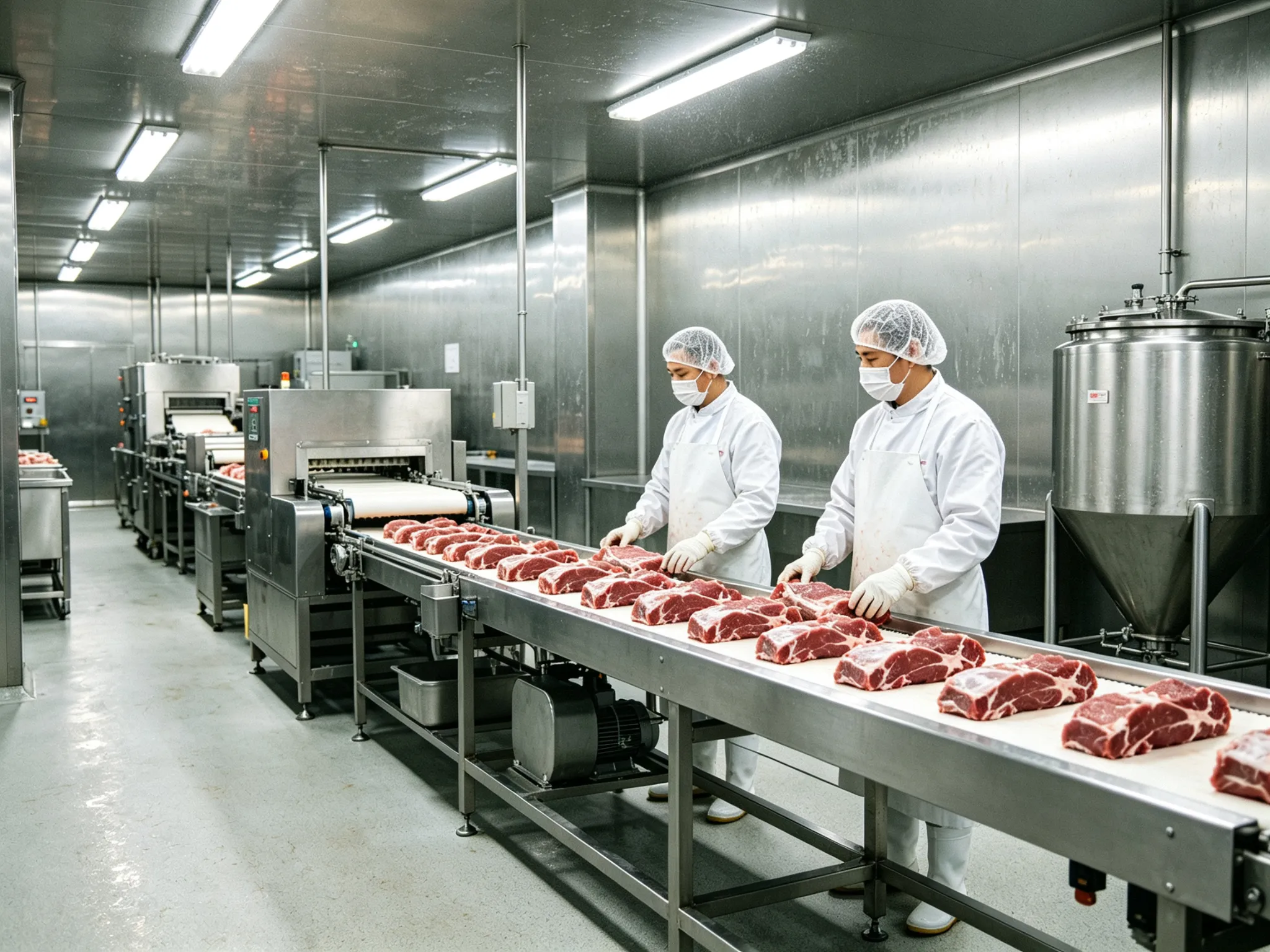
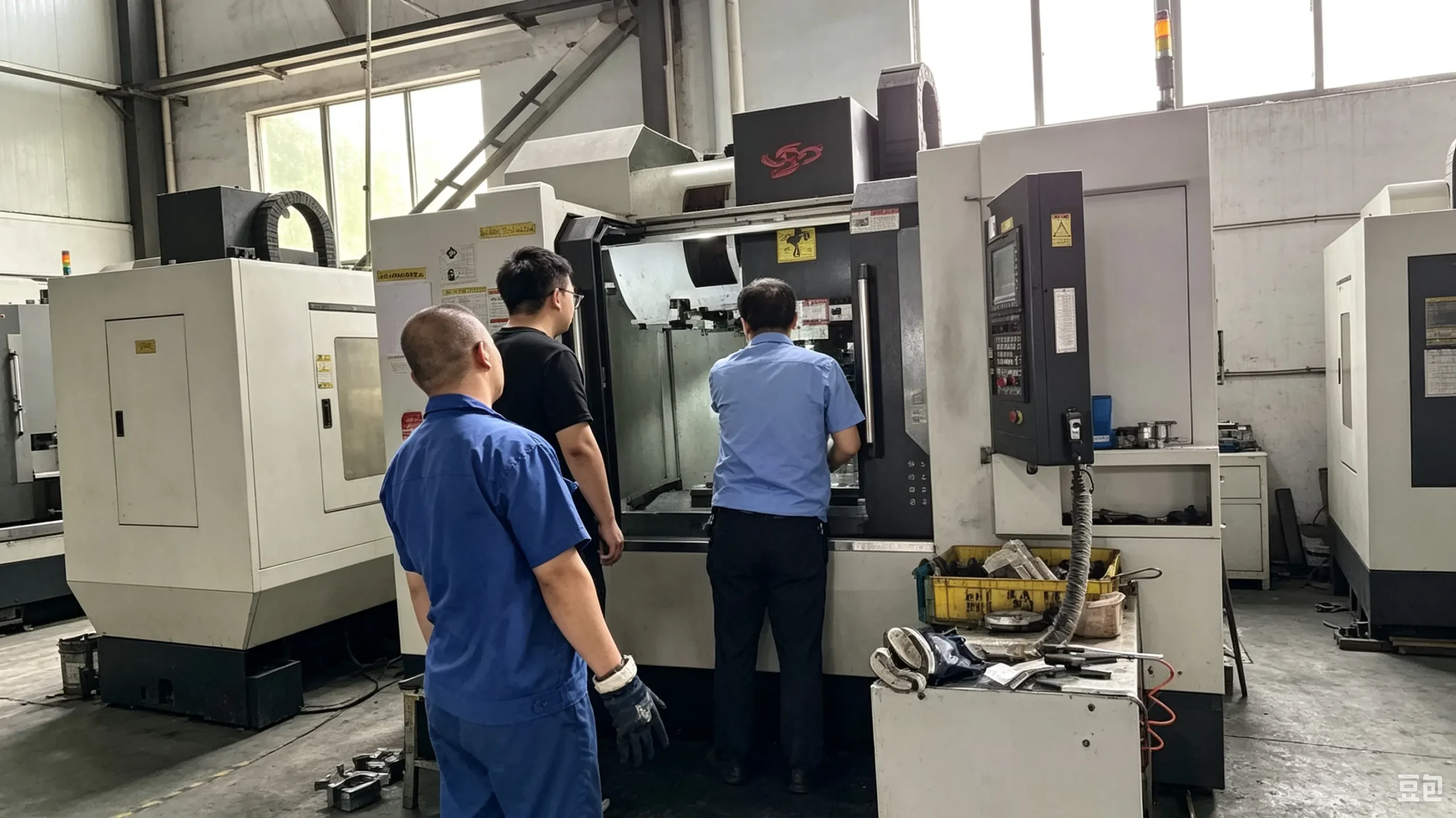
We are a Hangzhou-based manufacturer with over two decades of engineering experience in processed meat equipment. Our production facility at Shenhua Road operates CNC precision machining lines dedicated to vane assemblies, vacuum chambers, and stuffing horn components — the three subsystems where dimensional tolerance has the biggest impact on air-pocket performance at high throughput.
Our Certifications




CNC-Machined Vane Sets
Manufactured to ±0.01 mm clearance tolerances, our vane sets maintain volume accuracy across the full duty cycle without the gradual drift common in cast components.
Global Export Track Record
Our machines operate in sausage and frankfurter plants across Southeast Asia, Europe, and the Americas, with support networks in over 30 countries.
48-Hour Spare Parts Dispatch
Critical wear parts — vanes, seals, horn sets — ship from Hangzhou within 48 hours under standard stock conditions, minimising unplanned downtime on your filling line.
Line Integration Support
Our engineering team provides synchronisation wiring diagrams and PLC parameter files to integrate our filler with third-party clipping, linking, and hanging lines on-site.

Recommended Product
The machine described throughout this guide corresponds to our flagship vacuum sausage filling machine, the ZKG-6500. Purpose-built for high-volume collagen casing operations and continuous integration with automatic clipping and hanging lines.
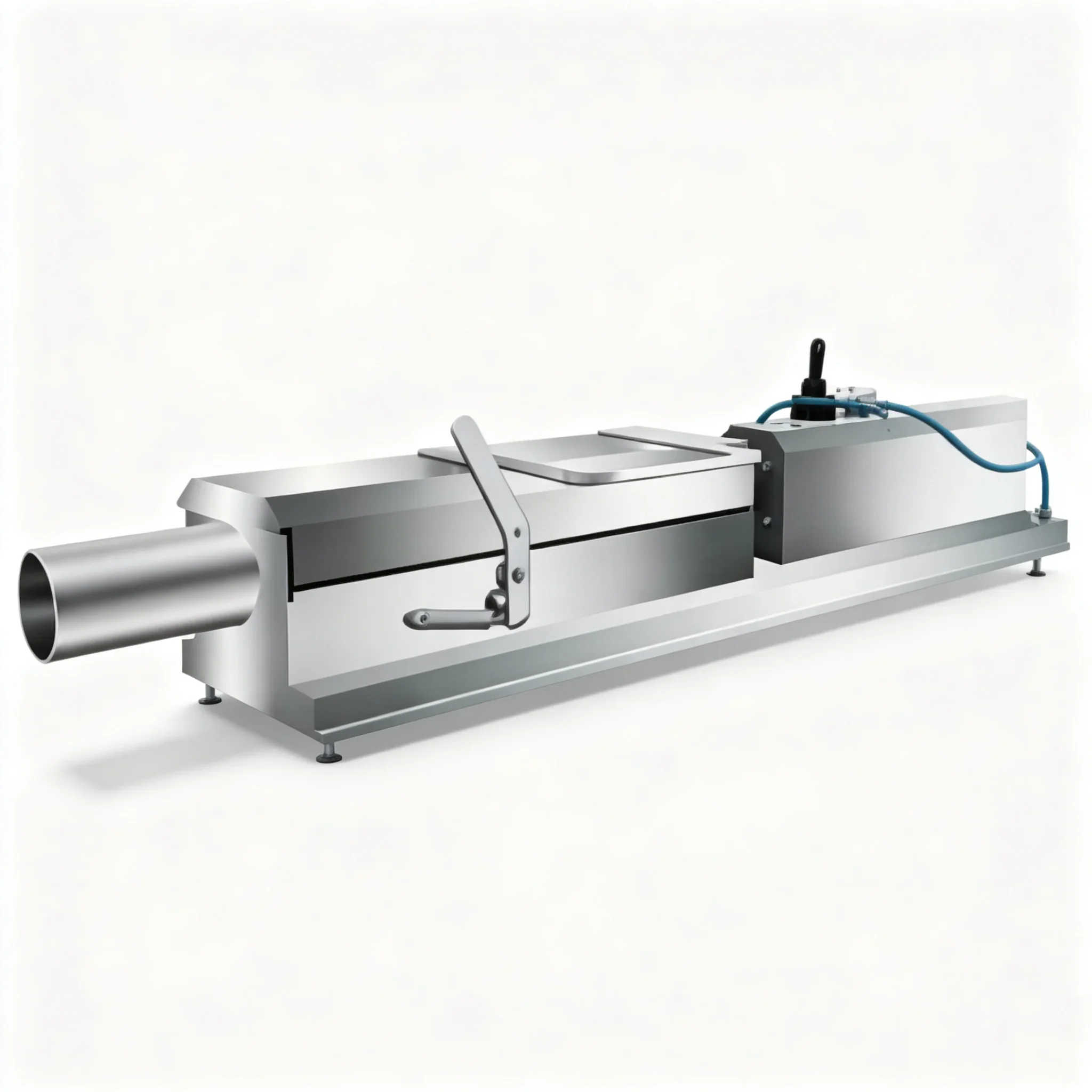
ZKG-6500 Vane-Type Vacuum Filling Machine
- Output: up to 6,500 kg/h
- Chamber vacuum: up to −0.9 bar
- Casing compatibility: Φ13–Φ120 mm
- PLC portion control with encoder feedback
- Full stainless steel (304) wetted parts
- Synchronisation output for clipper / linker integration
اکثر پوچھے گئے سوالات
Ready to Eliminate Air Pockets from Your Sausage Line?
Speak with our engineering team about the ZKG-6500 and how it integrates with your existing collagen casing production line. We provide vacuum parameter setup guides, horn selection charts, and PLC synchronisation support.
📍 Shenhua Road, Hangzhou, China 310031 | 📞 +86 13083988828